

Following the FDA’s recent move to encourage non-animal models (NAMs) for drug testing, the research community is rapidly shifting toward more human-relevant, ethical, and predictive systems.
We spoke with Amy Van Aartsen, a scientist from University of Wisconsin-Madison, about her experience with NAMs and how single cell RNA sequencing (scRNA-seq), particularly the Evercode™ assay, has advanced her research. The technology’s versatility and scalability have enabled her team to perform high-throughput profiling across multiple time points.
But Amy is more than a scientist. She is the co-founder of The Marty Project, an initiative advocating for evidence-based policies to replace dogs in product safety testing with scientifically validated alternatives. It’s hard to imagine a cause more worth supporting.
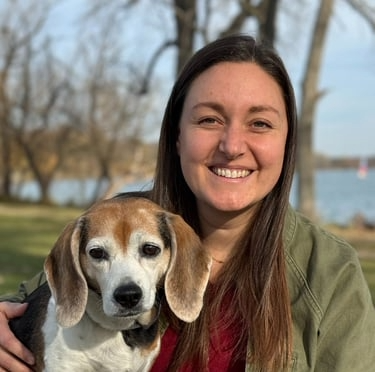
Amy Van Aartsen and her sweet Maggie.
During your tenure in cardiovascular research you and your colleagues used human induced pluripotent stem cells (hiPSCs) to differentiate and obtain cells of interest. Why do you think the lab has gone in this direction?
Amy: I think that hiPSCs revolutionized our ability to derive patient specific cell lines, making it remarkably more accessible to obtain not only human-relevant data but also patient-specific data. The ability to differentiate hiPSCs into mature cell types is the foundation for stem cell-based research applications. Our lab has previously developed protocols for the differentiation of hiPSCs into mature cardiac cell types, and I think this focus has been because of the multitude of applications ranging from disease modeling to the advances made towards regenerative therapies. I believe that hiPSCs have been a crucial development as we continue to move towards achieving personalized medicine in the future. I’ve also personally found it incredibly rewarding to have the privilege of working with patient-derived diseased cell lines. I’m grateful for the patients who have made this human relevant research possible, and I hope that our scientific contributions provide value to them individually as well as to society.
How effective are hiPSCs in studying heart disease, and could these methods one day fully replace animal testing?
Amy: HiPSCs have drastically improved our ability to study heart diseases and are particularly effective for applications at the cellular and molecular level, allowing for sophisticated in-vitro models. When used in conjunction with other non-animal methods (NAMs), such as computational and high-throughput screening approaches, I think that any rationale for animal testing has already become obsolete. I believe that animal testing only continues to exist today because of the existing regulatory framework, but that landscape has profoundly shifted in recent months with the trio of announcements from the FDA, NIH, and EPA, who have all committed to phase out animal testing in favor of evidenced-based, human-relevant methodologies. There are of course limitations to any model, including hiPSCs, but when over 90% of drug candidates pass pre-clinical animal testing but then fail to be safe or effective for human use, we need to critically evaluate the existing system. I would personally conclude that in addition to the tremendous ethical concerns, animal testing is ineffective and has been more of a hindrance to scientific and medical progress because the data we are making decisions from is largely irrelevant for human use. The goal of animal testing was to determine safety and efficacy testing for human use, but dogs are such poor predictors of human biology that the data has led us astray and inadvertently put patients at risk. Of course, there will be questions we can’t ask without the use of in-vivo animal models, but I believe that’s a necessary shift as we need to consider the purpose of the questions we were previously asking and recognize the data we were obtaining wasn’t useful or ethical. I believe that even if there are some limitations with NAMs currently, working with the available methodologies and investing in advancement of these improved techniques is better for us and dogs alike.
In your upcoming paper, you and your colleagues selected Parse Biosciences to study the transcriptome of cells throughout the differentiation process. What factors influenced this choice?
Amy: The versatility and scalability of Parse’s platform while simultaneously giving us a robust, reliable dataset were critical factors in our decision. Parse has done a fantastic job developing outstanding scRNAseq technology paired with thoughtfulness for the end user. Since we wanted to do scRNAseq for a time course study, the ability to fix and permeabilize cells for later use made it possible to complete our entire study and then process all the samples at once. This mitigated any concerns about batch effects and prevented the financial risk that would have been inherent to investing in scRNAseq before completion of our time course experiment.
What difficulties, if any, did combinatorial barcoding help you solve?
Amy: Parse’s Evercode combinatorial barcoding technology gave us the autonomy to scale up the number of cells in our experiment with improved sensitivity to capture gene expression. This gave us confidence that we were able to accurately characterize the different cell clusters present in our samples. At the same time, Parse’s workflow gave us the flexibility to check sequencing efficiency and determine the depth of sequencing to make informed decisions, ensuring our scRNAseq experiment was resource efficient and we could allocate sample sizes accordingly. Being able to use standard lab equipment to prep samples made the entire process streamlined and readily accessible for our lab. We were also impressed with the functionality and user-friendly nature of Trailmaker.
Lots of scientists are now switching to scRNA-seq for their explorations. Is there any recommendation you would give to a newbie before they embark?
Amy: I would absolutely check out the resources on Parse’s website. Parse has built an outstanding one-stop-shop for all resources related to scRNAseq, making it easy to learn about the technology and implement scRNAseq.
Switching gears, your passion for animals extends beyond avoiding their use as laboratory models. You’ve made it your life’s mission to end the use of dogs in human product safety testing. Tell us about The Marty Project.
Amy: The Marty Project is a promise to dogs to end the use of dogs as laboratory models. As a non-profit organization, we work to establish public policy that promotes the replacement of dogs in human product safety testing with evidence-based scientific alternatives. The Marty Project is named after Marty, who was my co-founders’ beloved beagle. Marty unfortunately spent the first part of his life in a research lab where he was used for pre-clinical drug testing. At 6-years old, Marty touched grass for the first time when he was finally rescued from the lab and adopted. While traumatized from his years in the lab, after he was rescued, Marty lived his absolute best life enjoying adventures and the love of his family. While he has sadly passed, The Marty Project is his legacy and inspires us daily to create systemic change by ending dog experimentation. For me personally, my beagle Maggie means the absolute world to me. Ever since I was a kid, I’ve always had beagles in my family, and I’m forever grateful for the beautiful relationships I’ve had with each of my pups.
Dogs truly are man’s best friend, and all dogs deserve a world that reflects that. When I first heard about the issue of using dogs in laboratory settings, I was appalled and as a scientist started to learn how this could possibly be happening – tens of thousands of dogs are used for experimentation annually in the US alone. It has been a powerful realization to see that there is absolutely an attainable solution to ending dog experimentation: implementing non-animal methods (NAMs). The Marty Project seeks to elevate and expedite implementation of human relevant methods, such as techniques using hiPSCs, which have repeatedly shown to be more reliable and accurate than using dogs for testing. The Marty Project seeks to do right by dogs by promoting full implementation of NAMs. We believe in creating a world where science advances and dogs are in laps not labs.

This is Marty. At the age of six, Marty was given to a rescue organization in Wyoming where he saw the grass, sun, and blue sky for the first time in his life. This is also where he first met his human mom Ellie, co-founder of The Marty Project.
At Parse, we have a “Pets of Parse” channel where we share updates on all our furry family members, so this topic is close to our hearts. In your view, what would it take to truly move the needle on changing the conversation around animal testing and shifting toward alternative research methods?
Amy: I love that you tied this back to the Pets of Parse channel, and we are so incredibly grateful for Parse’s support on this issue. Having companion animals in our lives is the best. Our tagline is “for the love of dogs, boldly connecting people, science, and policy”, and I think to truly move the needle on changing the conversation around animal testing we need to have cross-sector collaboration. It’s critical to have Parse and other biotechnology companies invested in changing the system for the better and advancing the conversation. As a new organization, much of our work to date has been focused on laying the groundwork for introduction of public policy by initiating conversations and educating policy makers, scientists, and animal lovers on the issue. We absolutely need more perspectives contributing to this conversation and expressing support for the implementation of NAMs. We have been incredibly encouraged to see that at the federal level the FDA, NIH, and EPA have all made announcements focused on phasing out animal testing, but it’s going to take all of us working together to make the desired change. As regulatory agencies are working to validate and implement NAMs, I believe that Parse and other biotechnology companies can productively contribute to expediting change by highlighting the applications for their NAMs technology and expressing their unwavering support for full implementation of NAMs. We are absolutely delighted to be partnering with Parse to help usher in the next wave of discovery and simultaneously promote dog welfare.
Good luck Amy and sweet Maggie! Parse and their pets are with you.
If you want to donate to the Marty Project, find the link here.