


High-Throughput Single Cell Profiling of a Drug Screen with Evercode WT Mega 384
Key Takeaways:
- Time-resolved single cell data reveal early and subclass-specific transcriptional responses to 88 histone-modifying compounds across multiple time points
- Automated and non-automated workflows produce equivalent single cell transcriptomes, with uniform clustering and matched cell type proportions across 384 samples
- High capture efficiency from as few as 10,000 cells per sample, enabling large-scale screens with limited cell input
Experimental Design:
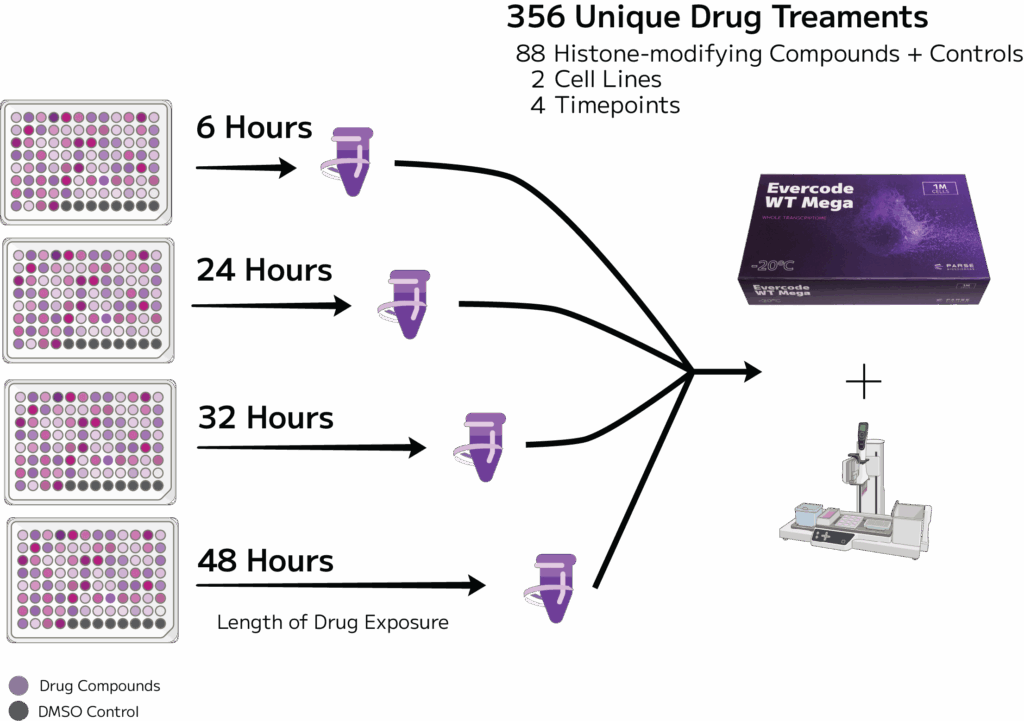
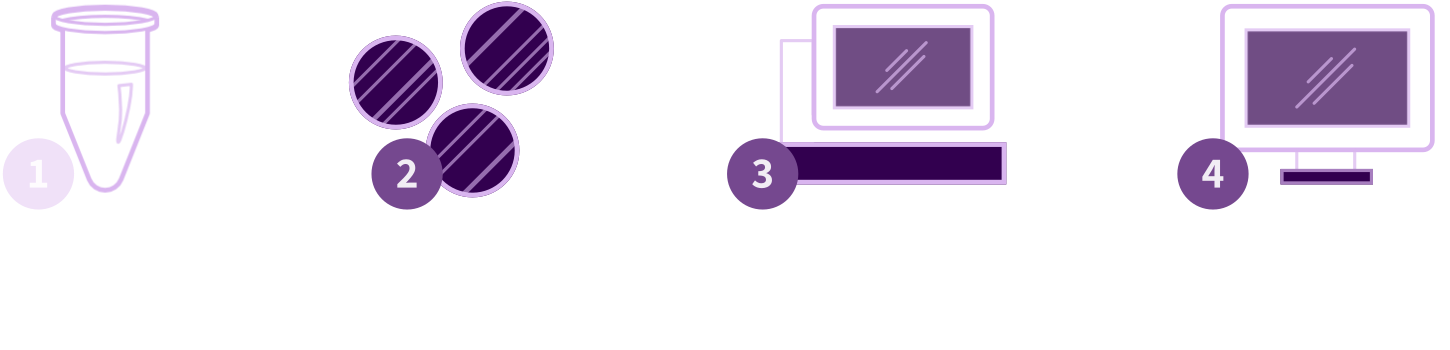
To evaluate the high-throughput performance of Evercode WT Mega 384 with low-input samples, we profiled 88 histone-modifying compounds across two cancer cell lines: A549 (lung carcinoma) and THP-1 (acute monocytic leukemia).
Each 96-well plate contained a full panel of 88 drug treatments plus DMSO controls, with each well seeded with approximately 20,000 cells and treated at 2.5 µM. For each cell line, four replicate plates were prepared—each assigned to one of four treatment durations: 6, 24, 32, or 48 hours.
Cells were fixed using the Low Input Fixation workflow, processed through the Evercode WT Mega 384 kit automated using Integra Assist Plus pipetting robot, and sequenced at ~10,000 reads per cell.
Results:
Single Cell Resolution of Early Drug-Induced Changes to Transcriptional Programs
Bromodomain and HDAC inhibitors produced the strong transcriptional shifts in THP-1 cells (Figure 1). Bromodomain inhibitors triggered an early response between 6 and 24 hours, followed by stabilization from 24 to 48 hours, indicating early target engagement and cellular adaptation.
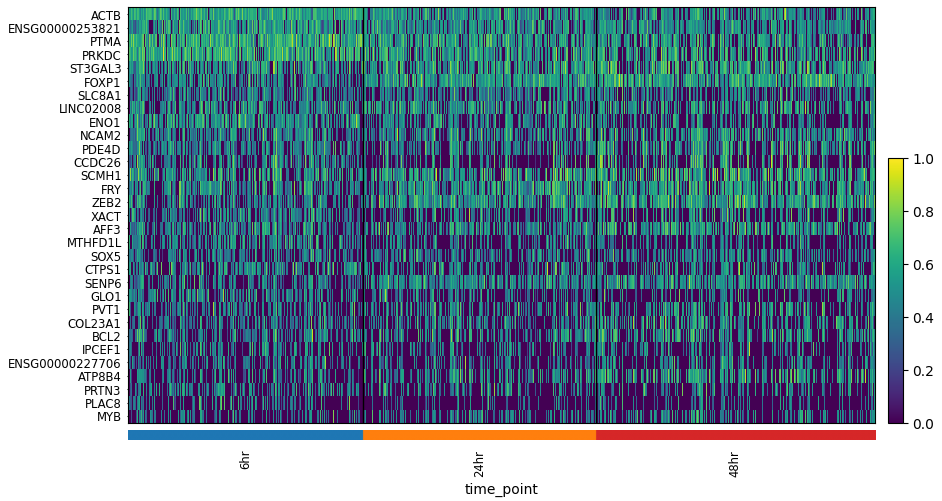
Figure 1: Time-dependent transcriptional response to bromodomain inhibitors in THP-1 cells. Heatmap of top differentially expressed genes across 6, 24, and 48 hr compared to DMSO controls. The major shift occurs between 6 and 24 hr, with expression stabilizing by 48 hr.
At 24 hours, several compounds showed distinct transcriptional fingerprints. UNC1215 and UNC669 clustered together, while -JQ1 and RVX-208 formed a separate group, highlighting subclass heterogeneity (Figure 2).
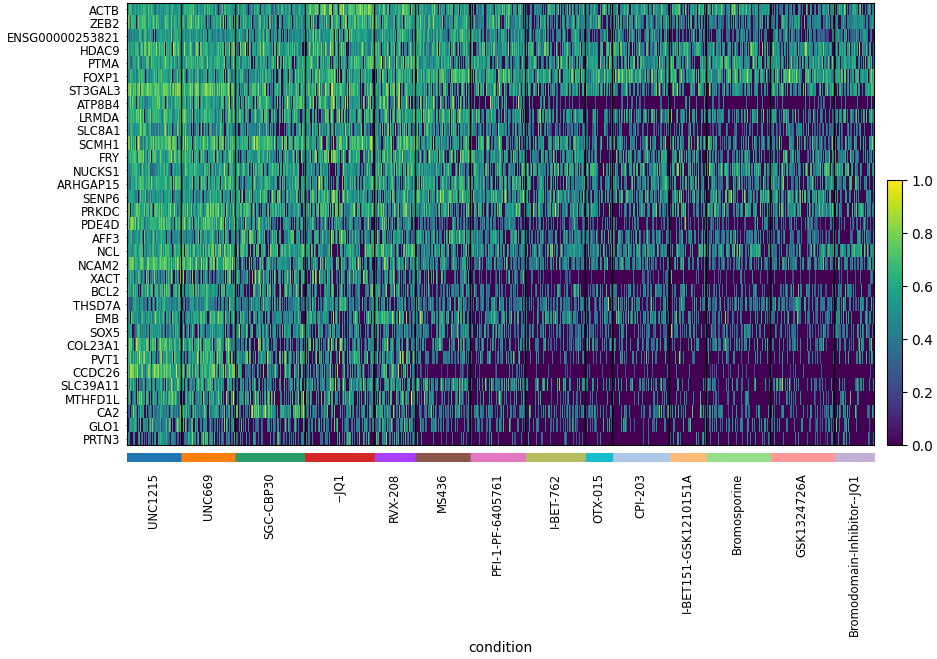
Figure 2. Subclass-specific expression profiles among bromodomain inhibitors. Heatmap of top DE genes at 24 hr across 15 compounds. Compounds with shared mechanisms cluster together, revealing distinct transcriptional fingerprints.
Robust Capture Across Low-Input Samples
The Low Input Fixation workflow supports efficient recovery from inputs as low as 10,000 cells or nuclei per sample, enabling perturbation screens using limited material.
Retention rates ranged from 65% to 89% across diverse sample types, including PBMCs, mouse liver nuclei, and HEK/3T3 nuclei and whole cells, demonstrating consistently high capture efficiency (Figure 3).
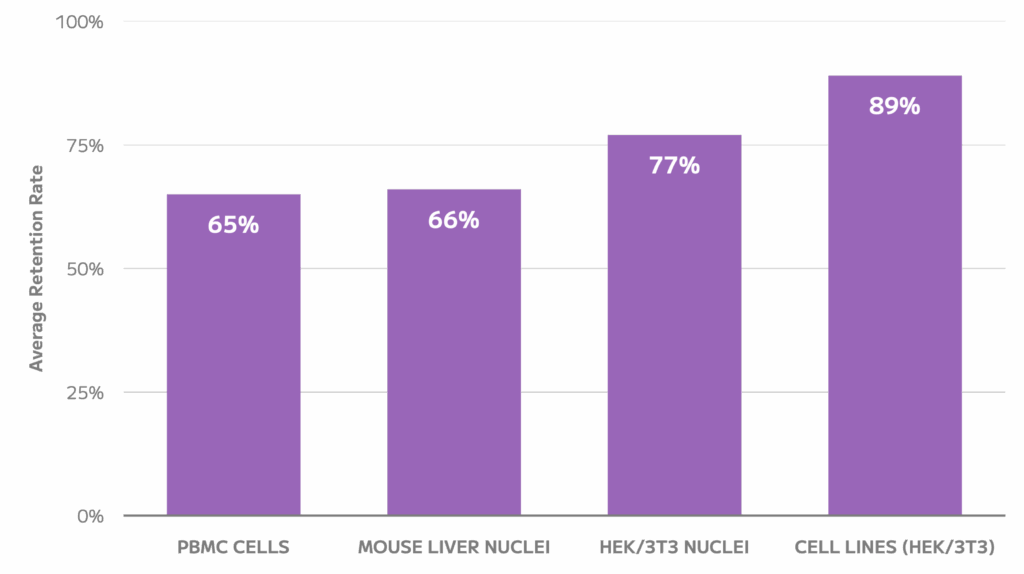
Figure 3. Robust Low Cell Input Capture rates. Average retention rates remained high across a range of low-input cell and nuclei types. These were performed using the non-automated low-input fixation workflow.
Automation Reduces Hands-on Time Along the Workflow
Evercode WT Mega 384 is compatible with both non-automated and automated workflows. While non-automated processing remains a straightforward and accessible option, especially for labs without access to automation, automation reduces user hands-on time across key steps.
In this experiment, automation reduced hands-on time by approximately 3.5×, streamlining barcoding through library prep (Figure 4).
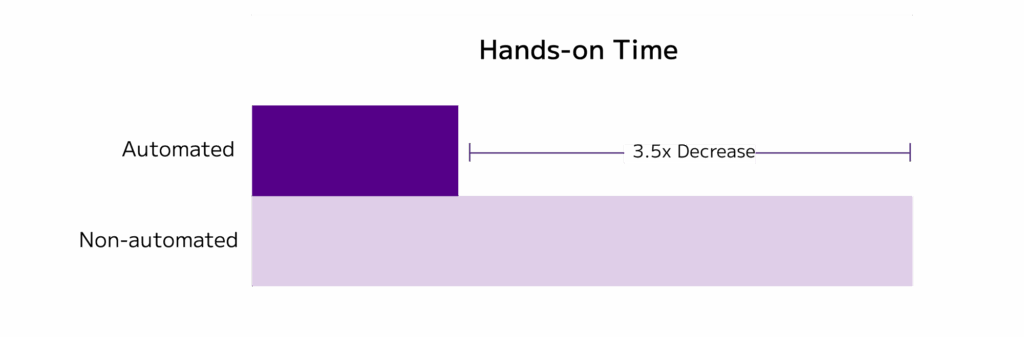
Figure 4. Automation reduces hands-on time by 3.5×. Comparison of hands-on time for 384 samples using automated vs. non-automated workflows. Time includes barcoding through library prep only.
Matching Cell Proportions and Transcriptional Profiles
Automated processing yielded cell type proportions and transcriptional profiles equivalent to non-automated samples.
Integrated UMAPs show that automated and non-automated cells co-cluster across both THP-1 and A549 samples (Figure 5). Cell type contributions remained near 1:1 across all clusters (Figure 6), confirming that automation introduces no detectable bias in transcriptional output.

Figure 5. UMAPs show near-identical transcriptional landscapes between non-automated and automated workflows. UMAP colored by processing method. It is colored by processing method and shows uniform integration. The UMAP was generated using Trailmaker.
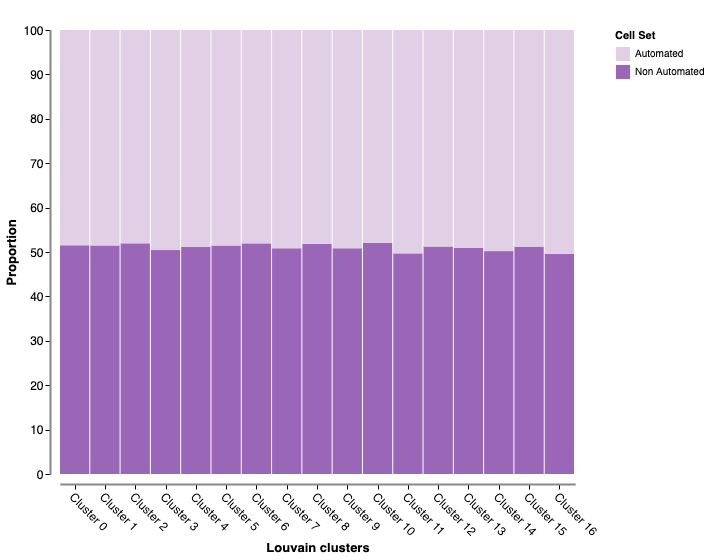
Figure 6. Consistent representation of automated and non-automated cells across all clusters. Each bar represents a cluster from the integrated dataset, with colors indicating the proportion of cells originating from either the automated (light purple) or non-automated (dark purple) workflow. The nearly 50:50 distribution across all 17 clusters confirms that automation does not skew cell type recovery or cluster representation. The frequency plot was generated using Trailmaker.
Evercode WT Mega 384 enables high-throughput single cell drug screening—even from low-input samples. With the addition of automation, researchers can now process hundreds of samples in parallel while dramatically reducing hands-on time and labor.
Whether you’re screening drug candidates, profiling organoids, or working with precious primary samples, this workflow delivers the scale and consistency needed for powerful discovery, without sacrificing sensitivity or reproducibility.
Next Steps
- Explore the data in Trailmaker:
- Click ‘Explore’ next to the dataset “Mega 384 Automated Drug Screen” in the Trailmaker data repository.
- You’ll need to create a free account if you don’t already have one.
This dataset is licensed under the Creative Commons Attribution-NonCommercial 4.0 International (CC BY-NC 4.0) license. Non-commercial users are free to share and adapt the data by providing appropriate credit – Parse Biosciences citation guidelines are available here. If you’re interested in licensing the data for commercial purposes, visit our Dataset Commercial Licensing page.
Downloads
We're your partners in single cell
Reach out for a quote or for help planning your next experiment.