

Proof of concept alone won’t win you a grant anymore.
Large scale transcriptomic data generation has shifted the scientific funding landscape.
When moving from small to large scale experiments, success hinges on different math: operations and infrastructures, data governance and management plans for massive datasets.
And more importantly, whether the data generated is architected well enough to train foundational AI models. A strong hypothesis is still necessary but no longer sufficient.
To get funding you need a strategic, execution-ready roadmap, and that changes how the whole project has to be framed and who you’re framing it for.
The good news is that large-scale scRNA-seq research is expanding globally, along with funding through government grants and private investments.
The Single Cell Market is Growing. What Does it Mean for Funding?
The single cell sequencing market is expected to grow from about $1.95 billion in 2025 to $3.46 billion by 2030, a 12.2% compound annual growth rate (Figure 1).
When considering the full single cell analysis market, including alternative isolation methods, spatial transcriptomics, and proteomics, the picture is roughly double: $4.32 billion in 2025, projected to reach $12.58 billion by 2034 at a 13.79% CAGR (Figure 2).
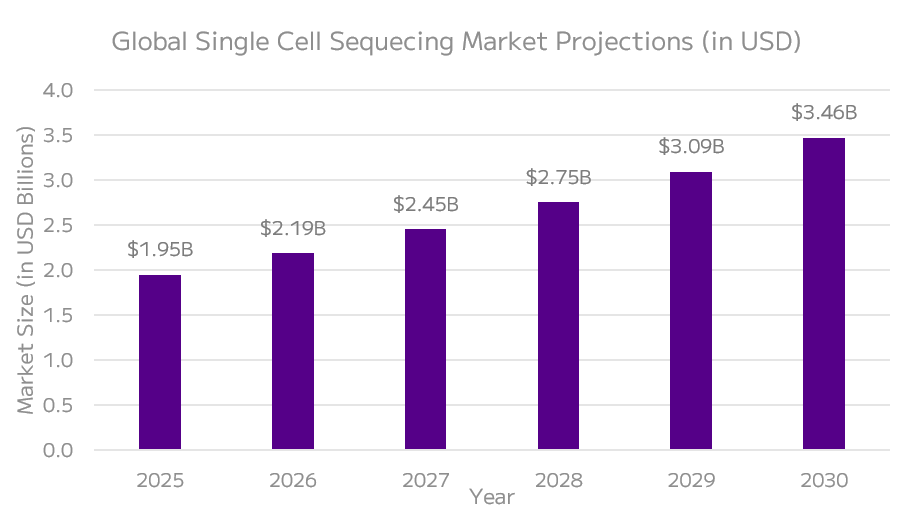
Figure 1: Expected global annual growth rate for single cell sequencing markets. Source: MarketsandMarkets Analysis, Report Ref: BT 9503 (Published July 2025).
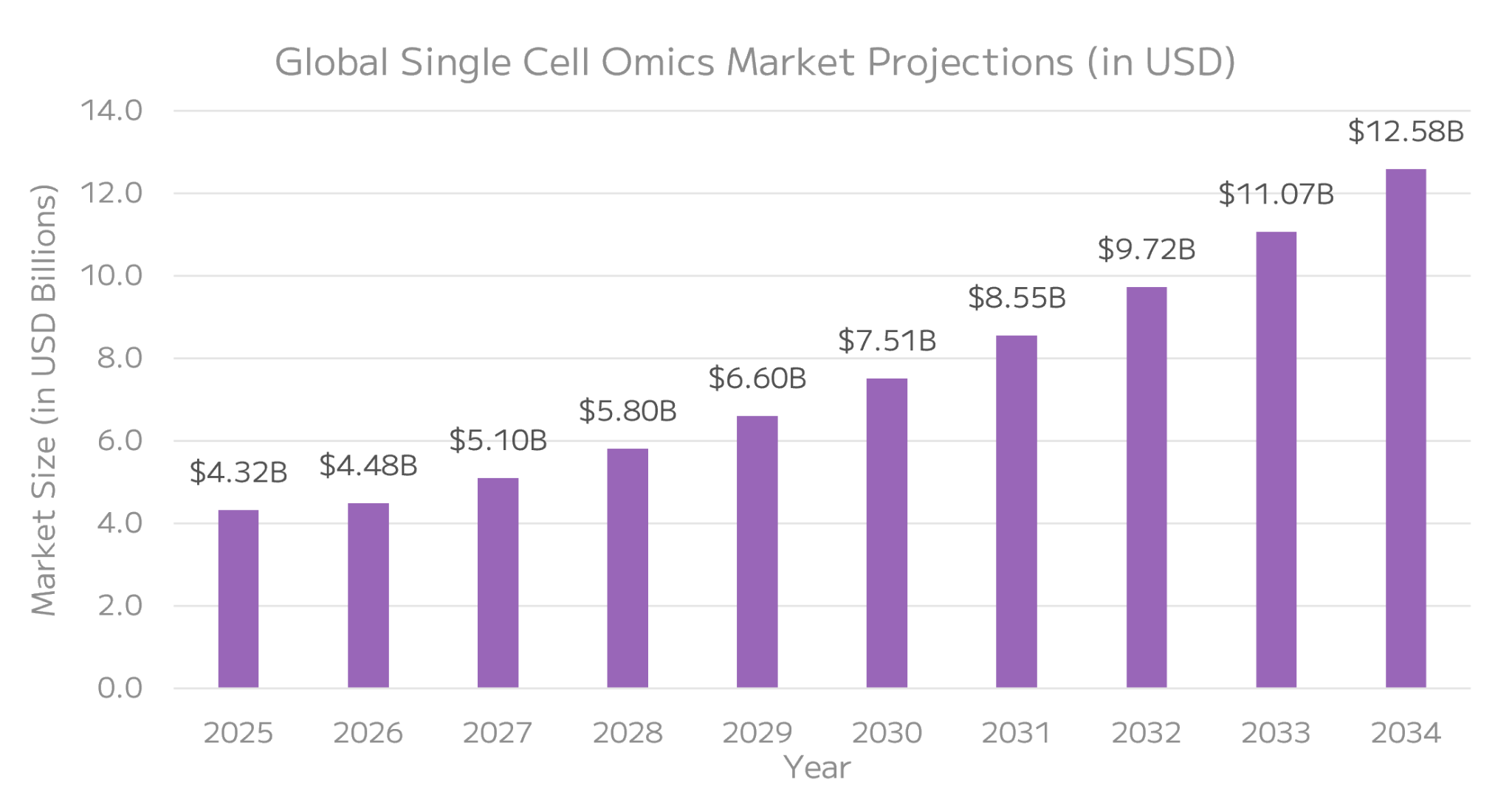 Figure 2: Expected global annual growth rate for multi-omics markets ((Flow Cytometry, NGS, PCR, Others). Source: Fortune Business Insights Analysis, Report ID: FBI105462 (Published June 2026).
The growth is driven by an overhaul of drug discovery pipelines, continued technical innovation, and the rise of cell and gene therapy, all accelerated by disease burdens that increasingly require single cell resolution to understand mechanism and design targeted therapy.
The money is there. The question is who you ask for funding, and whether your proposal speaks their language.
Know your Funders
NIH: Rigor, Preliminary Data, and the Peer-Review Argument
NIH still remains the largest public funder of biomedical research globally.
The NIH scaled up to multi-million dollar studies in four stages. In 2004, it built a “big science” framework via the NIH Common Fund, pooling funds for massive, multi-center projects. This was validated by TCGA and GTEx, which showed the framework could manage huge datasets. From 2012–2017, the Single Cell Analysis Program then invested $90 million to advance single cell tools and cut sequencing costs. With that technology now affordable, NIH scaled up further into body-wide mapping consortiums like HuBMAP and SenNet.
A winning NIH proposal is still a highly structured argument aimed at a peer-review panel: hypothesis-driven, backed by preliminary data that proves feasibility, with a clearly defined goal.
Philanthropy: Why They Fund Vision, Not Just Hypotheses
Private philanthropies reward vision.
For instance, the Chan Zuckerberg Initiative (CZI) is one of the largest foundations in the field: it funds and trains scientists in several countries, and it has been critical in the development of infrastructure. CZI funded and developed the Human Cell Atlas (HCA) Data Coordination Platform (DCP), a centralized cloud-based data portal for the HCA, to enable scientists worldwide to upload, process, and share massive single cell genomics datasets.
Its terms are not negotiable: data must land in publicly accessible repositories, and CZI is explicitly looking for collaborative, cross-disciplinary teams rather than single-PI labs.
The Wellcome Trust, a UK-based international foundation, has been one of the heaviest investors in the Human Cell Atlas itself, funding the collection, sequencing, and analysis work behind it.
The Virtual Biology Initiative is one of the most visionary examples of philanthropy and academic institutions joining forces. Biohub, the nonprofit research organization funded by CZI, has committed $500 million over five years to build predictive, AI-powered models of the human cell.
The funding splits two ways: $100 million to jump-start a coordinated, worldwide data-generation effort beyond what any single institution could undertake alone, and $400 million for Biohub’s own data generation, infrastructure, and next-generation technology for measuring, imaging, and engineering biology. Partner institutions include the Allen Institute, Arc Institute, Broad Institute, Wellcome Sanger Institute, Human Cell Atlas, and Human Protein Atlas.
Request for an Application: How you Do it
Foundations reward vision over caution, where “vision” turns into a proposal that names a specific scientific gap and connects it to a measurable, global impact through collaboration and technology.
Practically, that means:
- Start with the Letter of Inquiry (LOI). Most applicants are screened out at this stage, and it’s typically just one to two pages. Write for a scientifically literate but non-specialist reader, in a direct tone.
- Keep the background to one paragraph. These proposals run far shorter than an NIH submission: address the gap in the first paragraph, not the third.
- Describe an approach, not a protocol. Where NIH wants methodological detail, foundations want to see the strategy.
- Name the repository, timeline, and metadata standards explicitly. Open data isn’t a nice-to-have, it is a requirement.
- Show a team, not a lab. Foundations do not just check if the team can execute, they specifically reward integrated teams where biologists, software engineers, and data scientists share ownership of the project design.
- Define the outcomes, and how you will measure them. Vision still has to resolve into something countable.
Industry Partnerships: The Newest and Least-Understood Path
This is the path most academics are least prepared for, because it requires a complete frameshift, not just a shorter document.
Where a grant proposal argues that a hypothesis is worth testing, an industry pitch argues that you already have something the company needs and can’t easily get anywhere else.
Here is recent proof of what this model can produce: in December 2024, Vevo Therapeutics (since renamed Tahoe Therapeutics), a company spun out of research at UC Berkeley and UCSF, partnered with Parse Biosciences’ GigaLab to generate the Tahoe-100M dataset: 100 million cells across 60,000 experimental conditions, mapping 1,200 drug treatments against 50 tumor models, completed in about five weeks. Vevo’s Mosaic platform designed the experiments, Parse’s GigaLab ran the single cell RNA sequencing at scale using Evercode technology, and Ultima Genomics’ UG100 provided high-throughput, low-cost sequencing.
Two months later, the dataset became the founding contribution to the Arc Institute’s Virtual Cell Atlas, combined with Arc’s own 200-million-cell AI-curated dataset to form a 300-million-cell public resource, now one of the largest open single cell resources in existence.
This effort illustrates what industry partnerships look like in practice: a capability being deployed at a scale and speed no single academic lab could match on its own.
Industry Partnership Pitch: How You Do it
Asking for a Sponsored Research Agreement (SRA) starts with a pitch. The pitch needs to show, in half a page of business language the following: the biology, specific deliverables (datasets, reports) with hard timelines, a justified budget, an Intellectual Property (IP) framework spelling out who owns and who can use the resulting data, a publication policy, and data rights.
Frame the biology as a market opportunity, not a hypothesis. And be specific about scope: say plainly what you will and will not do, because doing unauthorized work outside the agreed scope is one of the fastest ways to trigger a contract dispute.
A few things that make or break these proposals:
- Lead with your asset. What do you have that they can’t easily replicate or acquire elsewhere?
- Frame for their pipeline, not yours. Read the company’s pipeline page and investor materials before you pitch: understand what problem they are trying to solve.
- Define scope explicitly. Ambiguity here is the single most common source of later disputes.
What Catches Academic Teams Off Guard in Industry Deals
A few things often catch academic teams entering industry partnerships off guard:
The Technology Transfer Office (TTO) has to be looped in early. The TTO negotiates terms, reviews the SRA, and protects the university’s interests. A large share of deals collapsed because the TTO was brought in too late to shape the terms rather than just review them at the end.
Confidentiality is written into the contract, not just a preliminary NDA. Substantive discussions typically can’t happen until an NDA is in place, but the confidentiality obligations don’t end there.
To publish the data, most SRAs include a defined embargo period, commonly 60–90 days, during which the company has the right to review any manuscript before submission. Publishing before that window closes is a breach of contract, regardless of when the science itself was actually finished.
This timing mismatch is the single most common source of tension in these partnerships and usually a surprise to the academic team.
Conclusion
The funding landscape for large-scale single cell research has split into genuinely different conversations and treating them as one is the most common way to lose.
NIH still rewards hypothesis-driven rigor and airtight preliminary data. Philanthropies like CZI and Wellcome want vision, open data, and integrated teams working toward measurable global impact. Industry partners want a clear, defensible asset, a tightly scoped deliverable, and a business case, not a hypothesis.
The Tahoe-100M partnership shows what’s possible when that pitch is made well: a dataset at a scale no single academic grant could have funded, built in weeks instead of years.
The market backing all of this has roughly doubled in the past few years. Capturing that growth isn’t just about having good science, it’s about learning to switch registers convincingly, and building the institutional habits, like engaging your TTO early and knowing exactly which clock you’re on, that keep a good idea from stalling out in someone else’s contract review.