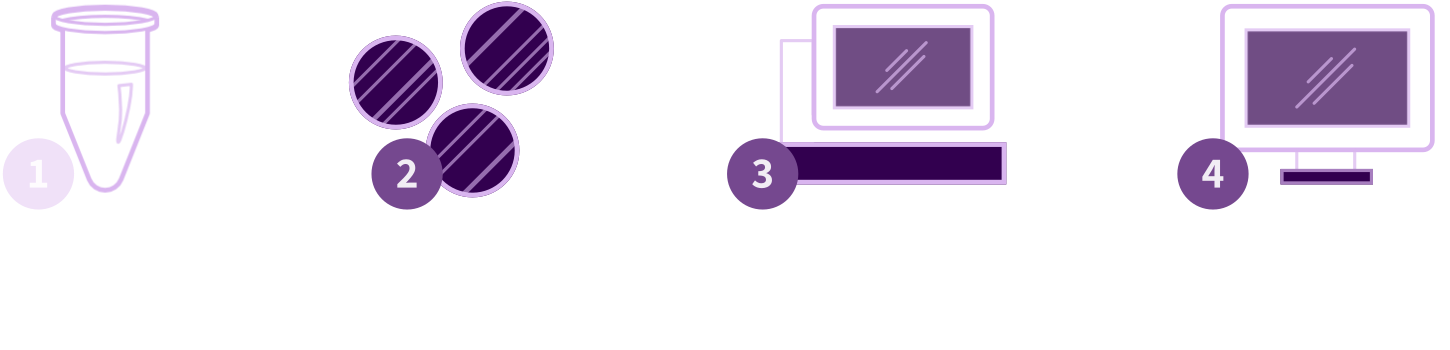
Our solution takes you from single cell or single-nuclei suspension through library prep and sequencing and delivers immediate results via our analysis software, Trailmaker.
Our solution takes you from single cell or single-nuclei suspension through library prep and sequencing and delivers immediate results via our analysis software, Trailmaker.
Discover your research personality through molecular biology
Celebrate RNA Day by discovering which RNA molecule matches your lab personality! This 5-question quiz reveals whether you’re the messenger driving projects forward, the transfer RNA keeping everything supplied, or perhaps the regulatory powerhouse fine-tuning results.
What’s your typical role during a lab experiment?
Designing the overall plan and handing off protocols to the rest of the team.
Prepping reagents, aliquoting, labeling tubes—you keep things moving.
Setting up the instruments and managing run schedules to optimize workflow.
Analyzing the data post-experiment, tightening up interpretations.
Working on background research and writing proposals or review papers.
In the lab, you’re most likely to be found…
At your desk typing up methods for the next figure.
At the bench, pipetting like a pro.
Coordinating time on the thermocyclers so everyone’s library prep is seamless.
At the computer, debugging your R scripts or tweaking figures.
At your computer with 50+ tabs open, deep in a PubMed rabbit hole.
When a paper gets accepted, what part of the project do you think really mattered?
A clear experimental design and logical story arc.
The execution—good prep and clean techniques.
Consistent workflows and reproducibility.
Clever data insights that elevate the figures.
The nuanced interpretation and hypothesis framing.
Your favorite lab tool or technique is:
A well-annotated protocol template.
Multichannel pipette or tube labeler.
The centrifuge or the thermocycler—when used properly.
The bioinformatics pipeline (you’ve customized it, of course).
Google Scholar + Zotero + color-coded highlights.
How do you handle a failed experiment?
You quickly identify what needs to be re-optimized and draft a new approach.
You double-check every reagent and protocol step—maybe something got contaminated.
You trace back the full timeline of the workflow and instrument logs.
You reevaluate the analysis pipeline—maybe it’s a data normalization issue.
You pull three papers on the topic to see if this has happened before.