

Ulcerative colitis (UC), a member of the Inflammatory Bowel Disease (IBD) family, is a chronic condition causing inflammation, swelling, and open sores of the colon. The disease affects over 1 million Americans of all ages, with 25% of them being pediatric patients.
 Pediatric UC symptoms are far more severe: the widespread inflammation involves the entire large intestine causing severe abdominal pain, GI bleeding, and weight loss.
Children with UC give up a carefree youth for constant pain and hospital visits. And their families trade playgrounds and family dinners with doctors’ offices and nights in a hospital.
An Assistant Professor at UAB Medicine witnessed the toll this disease takes from these young patients and their families and came to the realization that the field needs more research that directly benefits these young patients.
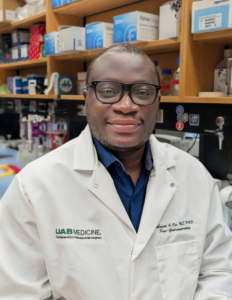
We had the pleasure of talking with Dr. Babajide Ojo to discuss how he and his lab are uncovering the molecular drivers of UC at single cell resolution. By utilizing organoids and single cell RNA sequencing (scRNA-seq), his team is identifying targetable mechanisms that can improve disease management by determining and how environmental cues shape the metabolism of the intestinal tract.
We discovered a rare combination: a human being with a profound commitment to finding the root cause of UC in children, and a brilliant scientist whose enthusiasm for science and his research is truly contagious.
If we look at your body of work over the last 10 years, you’ve mainly studied how nutrition affects metabolism and inflammation using preclinical models. Then, around 2021, there is a noticeable shift toward ulcerative colitis and the use of organoids as a disease model. What drove you to ulcerative colitis as a research focus?
When I was in grad school, I was interested in nutrition and its impact on the microbiome in obesity and type 2 diabetes models. Because that work relates to gut biology, it exposed me to other areas of intestinal biology.
What eventually drove me to inflammatory bowel disease (IBD) was a personal connection. One of my colleagues had three kids, and one of them had IBD, specifically Crohn’s disease. I then learned that IBD comprises majorly of two subtypes- Crohn’s disease and ulcerative colitis. While Crohn’s disease could impact any area of the intestinal tract, ulcerative colitis involves inflammation restricted to the lining of the colon.
That was the first time I was closely exposed to someone experiencing the disease. Learning more about it, I realized it is an area that needs more attention. There isn’t a definitive treatment or cure for IBD, and even nutritional management is still unclear.
I felt this would be a meaningful area to pursue after my PhD.
When I was graduating, I specifically looked for opportunities in the IBD field and found one in a group studying ulcerative colitis in children. I wanted to work in a more clinical, translational space, so that my research could one day directly benefit patients.
As for organoids, as basic scientists we typically rely on animal models, but toward the end of my PhD I learned about organoids and the ability to generate them from induced pluripotent stem cells or directly from patient tissue. That allows us to study the epithelial component of intestinal diseases in a way that better retains the molecular features and heterogeneity of human tissue. Because of that, therapies tested in patient-derived organoids may have greater translational potential than what mouse models alone have given us.
That’s really how I shifted my research focus to ulcerative colitis and organoids.
You developed what you call “colonoids.” Can you explain what they are, how you developed them, and what they represent?
Organoids can be developed from many organs, but we focus on gut-derived organoids. Specifically, we work with colon-derived organoids, which we call colonoids.
The colonoids we culture are primarily epithelial organoids, meaning they reflect the epithelial component of the parent colon tissue. That is important because IBD has a strong immune component, and most existing therapies target the immune system. However, there’s also a major epithelial component: the disruption of the epithelial barrier and epithelial cell death, that hasn’t been adequately addressed because we lacked good human epithelial models.
Epithelial organoids fill that gap, especially if generated from patient tissues. Current immunotherapies, especially in pediatric patients, are only effective in about 30% of cases. Many patients relapse, require therapy escalation, or even undergo colectomy. We believe that addressing the epithelial component alongside the immune component could lead to more holistic and effective treatments.
In your December 2025 publication, you reframe pediatric ulcerative colitis as a metabolic disease intrinsic to the epithelium and identify PPAR-dependent lipid metabolism as a candidate therapeutic axis. You integrated published single cell RNA-seq datasets for validation. What did single cell RNA sequencing add that bulk RNA-seq alone could not?
That’s a great question. We work with organoids from both ulcerative colitis patients and controls. Because organoids are cultured in stem-like conditions, we can study their transition from stem cells to mature epithelial cells.
What we found was that after about three days of differentiation, organoids from healthy and diseased patients diverged in the types of energy sources they use for respiration. That’s why we focused on metabolism: every cellular function requires energy, and if metabolism is disrupted, therapeutic responses will vary.
Bulk RNA-seq showed strong signals, but we needed to confirm that those signals were epithelial and not driven by immune contamination in patient tissues. ScRNA-seq allowed us to separate epithelial from immune cell populations and confirm that the metabolic signatures we observed in bulk data were truly epithelial and recapitulated in patient tissues. That validation was critical.
You have another paper coming out soon involving new single cell sequencing datasets using Parse. Can you elaborate on that work?
One of my key interests is understanding the role of environmental factors in IBD.
As I mentioned earlier, ulcerative colitis is complex and influenced by multiple components, including environmental factors. However, we still don’t fully understand which environmental exposures initiate or exacerbate the condition. Researchers are actively investigating contributors such as diet, lifestyle, and the gut microbiome.
During my postdoctoral work on our earlier project, I noticed that certain genes involved in sulfite processing were consistently dysregulated in pediatric ulcerative colitis (UC) samples. This pattern held across multiple datasets, not just our own. That observation led me to explore sulfite exposure in depth.
Sulfites are natural byproducts of cellular metabolism, particularly from the breakdown of sulfur-containing amino acids. Gut bacteria can also produce and utilize sulfites. However, an often overlooked source is dietary intake. Sulfites are widely used as preservatives in processed foods, and children may be disproportionately exposed due to their lower body weight.
Although the FDA considers sulfites safe and does not specify a recommended daily intake, there is an upper limit of 350 parts per million (ppm) as a food additive. While sulfite allergies are relatively rare, it’s possible that non-allergic individuals still experience subtle, unrecognized effects.
Some clinical evidence supports this concern. For example, a case report showed that removing sulfites and other components from a patient’s diet improved clinical remission. This suggests a potential link between sulfite exposure and epithelial dysfunction, especially since genes involved in sulfite detoxification appear impaired in the epithelium of these patients. Given that sulfites are inherently toxic and must be detoxified, this raised important questions.
To investigate, I conducted a study using scRNA-seq to examine how low-dose sulfite exposure affects human epithelial cells. We used organoids derived from pediatric patients and exposed them to approximately 6.3 ppm sulfite, which is well below the FDA labeling threshold on nutritional labels.
Interestingly, sulfite exposure in healthy organoids did not broadly alter transcriptional output. Instead, it specifically targeted non-coding RNA components of the Signal Recognition Particle (SRP) complex. This complex, composed of six proteins and non-coding RNAs (known as 7SL genes) in humans, plays a critical role in directing the translation of mRNAs destined for secretion or membrane localization. Interestingly, the SRP was also downregulated in organoids from donors with ulcerative colitis with or without sulfite exposure, suggesting that this complex may be impaired in disease.
Notably, this effect was cell-type specific: it primarily occurred in stem cell clusters during differentiation which could have significant downstream consequences in the regeneration of other colon cell types from the stem cells.
This initial finding in our single cell data was very exciting and led us to hypothesize that the cellular translational machinery may be impaired upon sulfite exposure. Building on this, we performed metabolomic analyses and found a consistent pattern: sulfite exposure selectively disrupted amino acid pathways. There was no significant impact on fatty acid or glucose metabolism, but amino acid uptake into cells was impaired.
We also conducted translational analyses, which further supported the conclusion that sulfite exposure during epithelial differentiation disrupts protein synthesis. Overall, this study, that used Parse Evercode technology for scRNA-seq, reveals a previously underappreciated mechanism by which dietary sulfites may affect intestinal stem cell function and epithelial biology.
We are currently developing this work for an upcoming publication.
You first used Parse at Stanford and later introduced it in your own lab. What made you want to use it again?
Before Stanford, we worked with 10x data that we weren’t very confident of its quality for many reasons. When I got an internal postdoc grant at Stanford, I decided to try the mini kit from Parse for my grant idea. We immediately saw higher gene recovery and better data quality, and this was important data for my NIH K99 grant. So, I decided to stick with Parse’s technology throughout my postdoc, and we still use this now in my own lab. One advantage Parse’s technology gave me during the target discovery phase was the robust recovery of Pol III–transcribed RNAs like the 7SL genes. For example, my data from Parse Evercode libraries detected ~50% of cells expressing the 7SL genes compared to a public 10x data in our field that detected these genes in ~1% of cells. This is likely because the Parse Evercode kits use hybrid oligo-dT and random hexamer priming during reverse transcription, which will enable better detection of non-polyadenylated Pol III transcripts like the 7SL genes unlike other technologies that depend mainly on oligo-dT-based capture of polyadenylated transcripts. Therefore, I may not have landed on 7SL gene targets in our sulfite exposure research if I had used a different technology from the start.
What advice would you give to beginners interested in single cell RNA sequencing, and Parse specifically?
Three things. First, develop a protocol that consistently yields high-quality single cells before committing to sequencing. That’s critical for any platform.
Second, don’t underestimate the value of the Parse mini kit. It’s enough to generate strong preliminary data for grants and even publications. I used it extensively in my own applications.
Finally, talk to people who have done single cell work, especially in your cell type. That guidance is invaluable.
—
Thank you so much Dr. Ojo, for your insight into ulcerative colitis in children and your recommendations to scRNA-seq first time users.